
AI Stocks: Where's the Real Growth and Where's the Excess Optimism?
 Raido Tõnisson, LHV securities markets analyst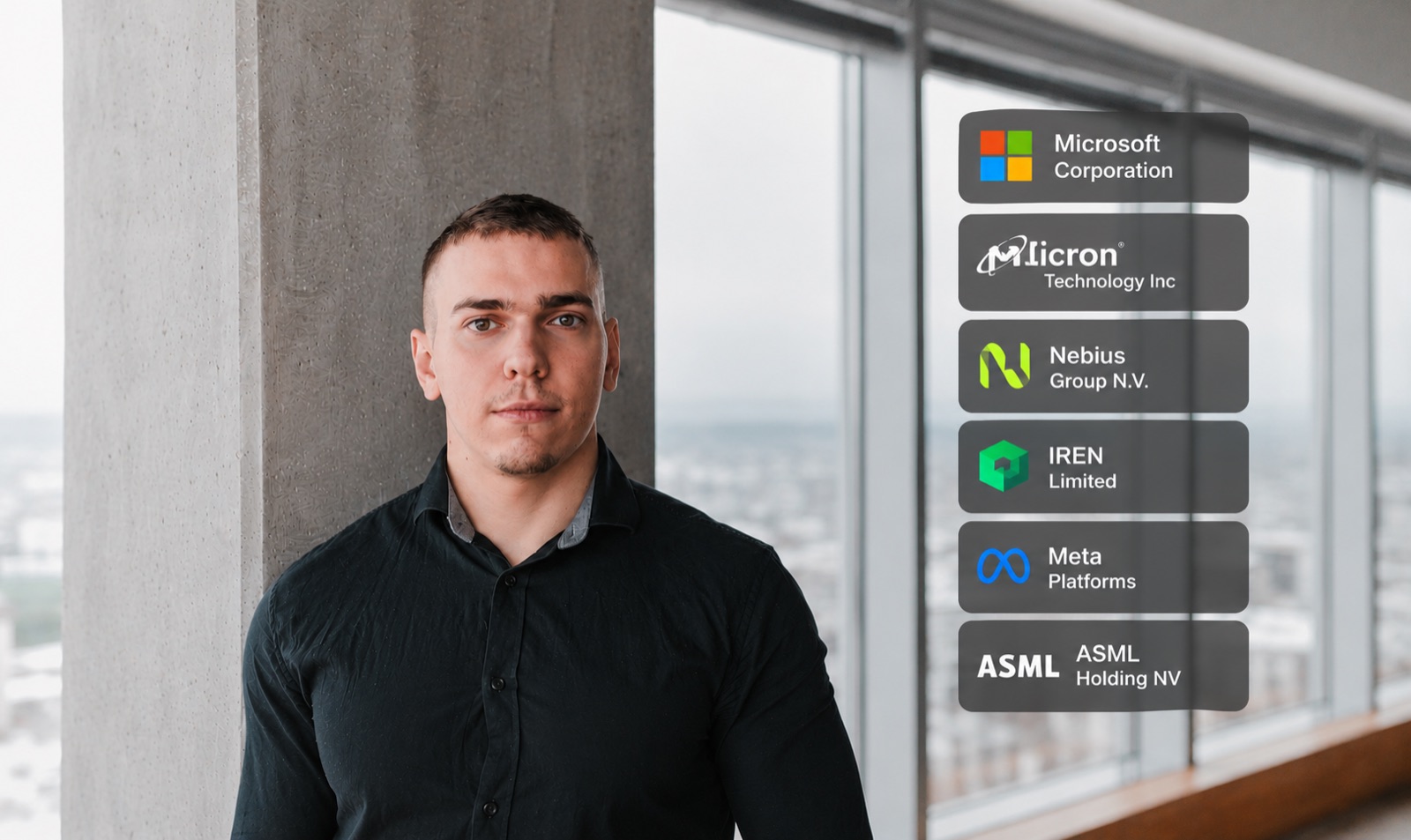
- LHV clients' most-bought technology stocks this year
- AI is no longer just a promise
- The AI value chain is much broader than a single winner
- Why do investors still like Microsoft and Meta?
- Nebius is a good example of how big opportunity goes hand in hand with big risk
- Chips and infrastructure may be a safer investment than the hottest names
- Where does the excess enthusiasm lie?
- What should a retail investor take away from all this?
Over the past couple of years, AI has been one of the hottest topics on the stock market. Big names like Microsoft, Meta, and Nvidia are on almost every investor's radar, but at the same time smaller and far riskier companies have emerged whose business is directly tied to building out AI infrastructure. The topic is unpacked by LHV securities markets analyst Raido Tõnisson.
LHV clients' most-bought technology stocks this year clearly show that interest isn't limited to just the world's largest companies. Alongside Microsoft and Meta, the most-bought include names like Nebius, Micron, ASML, AMD, and Oracle. This reflects a broader trend where investors no longer bet only on AI applications, but on the entire value chain — from chips and data centres to cloud services and enterprise software.
LHV clients' most-bought technology stocks this year
- Microsoft Corporation
- Micron Technology Inc
- Nebius Group N.V.
- IREN Limited
- Meta Platforms
- ASML Holding NV
- Atlassian Corporation
- Oracle Corporation
- Advanced Micro Devices
- Salesforce Inc
AI is no longer just a promise
While a few years ago AI was seen mainly as an exciting opportunity, it has now become a large investment cycle. Money no longer goes solely into developing new chatbots or image generators, but to a very large extent into making AI work at all. That requires data centres, electricity, cooling, network connections, memory chips, and specialised compute chips.
Bloomberg Intelligence estimates that the AI chip market could exceed 600 billion dollars by 2033. The reason is simple: conventional processors can no longer keep up with AI workloads, and an ever-larger share of computing power is shifting to specialised chips. The same analysis notes that AI-related capital expenditure could in the coming years total over 3.5 trillion dollars, showing this isn't a short-lived fad.
Large cloud providers and tech giants are investing tens and hundreds of billions of dollars because they see demand for computing power growing rapidly. At the same time, it's worth remembering that a very large investment wave doesn't automatically guarantee good returns for all participants. One company may gain a strong long-term advantage from it, while another gets stuck in a trap of high costs and weak profitability.
The AI value chain is much broader than a single winner
To the average investor, AI may seem like one big theme, but it actually divides into several layers.
The base — the very bottom layer — is the chip world. This includes, for example, Nvidia and AMD, which produce the compute chips AI needs, and Micron, which makes memory chips. Without fast memory and powerful compute, large AI models can't be trained or used. ASML also belongs in this group; its machines are essential for producing the most advanced chips.
The next layer is the cloud and data centres. Here Microsoft, Oracle, and smaller infrastructure providers like Nebius are in play. There's a lot of excitement in this layer right now, because a shortage of computing power has forced companies to quickly build new data centres. The more electricity and equipment they can connect to the grid, the more AI computing power they can offer customers.
The third layer is services and applications. This includes, for example, Meta, Microsoft's software products, Salesforce, and Atlassian. These companies are trying to use AI to improve their existing services, add new paid features, or make work processes more efficient. Their advantage is that they already have a large customer base and strong cash flows to invest in AI.
This is exactly where the key difference lies. One company earns money from AI indirectly, strengthening an existing business. Another builds its entire story on AI demand growing for many more years in a row.
Why do investors still like Microsoft and Meta?
Microsoft is also at the top of LHV clients' purchasing preferences. That's no surprise. Microsoft is at once a cloud provider, an enterprise software vendor, and one of AI's biggest funders. Its strength is that it doesn't have to rely on a single product or market niche. As AI use in companies grows, Microsoft benefits through cloud services, office software, and business applications.
Bloomberg Intelligence considers Microsoft one of the largest buyers of AI computing power and forecasts that the company's capital expenditure will stay very high. Behind that is a desire to expand cloud infrastructure and serve ever-larger AI workloads.
Meta is a different story. Meta's core business is advertising and digital environments, where AI helps recommend content, target ads more precisely, and create new services. For an investor, this means Meta isn't an investment purely in AI infrastructure, but a company that can use AI to raise the profitability of its existing business. Such a model is often less risky than a growth story built purely on infrastructure.
Nebius is a good example of how big opportunity goes hand in hand with big risk
While Microsoft and Meta are familiar names to most investors, Nebius is far less known. Yet it has been one of those stocks that has drawn a lot of interest among LHV clients. The reason is understandable: Nebius operates in the AI infrastructure field and tries to offer customers much-sought-after computing power.
Nebius's business model is easy to state. Demand for AI computing power is very high, supply is limited, and those companies that can quickly bring new data centres and capacity to market can grow revenue exceptionally fast. The company is seen as supported by large partners, plenty of room to grow, and the ability to grow recurring revenue very quickly.
At the same time, the key question for Nebius is whether fast growth will ultimately also bring lasting profitability. Building AI infrastructure requires enormous outlays. Money goes into building data centres, acquiring equipment, securing power capacity, and getting the whole infrastructure running. If growth comes but achieving it requires spending a great deal of money year after year, investors' patience may at some point run out. The biggest risk lies in whether the company can grow fast enough that costs and debt load don't get out of hand.
Nebius's story shows well why, in the AI sector, it's not enough to just look at growth figures. You have to ask who pays for that growth, how long the negative cash flow lasts, and how strong the company's position is once competition intensifies.
Chips and infrastructure may be a safer investment than the hottest names
With every major technological shift, it's worth remembering the old adage: during a gold rush, those who sell shovels often earn most reliably. With AI, those "shovels" are chips, memory, network equipment, and manufacturing technology.
This is where Micron, AMD, and ASML come into play. Micron benefits from the fact that AI servers need ever more and better memory. According to Bloomberg data, memory and data-movement speed have become one of the main bottlenecks of AI infrastructure. With AMD, investors' hope is tied to whether it can offer the market a credible alternative to Nvidia's solutions. ASML, meanwhile, sits in an entirely different link of the value chain: without its machines, it's impossible to make the most advanced chips the whole AI ecosystem needs.
These companies may not always be in the headlines, but their advantage is that they earn from growing AI use regardless of which specific application or model ultimately turns out to be the winner.
Where does the excess enthusiasm lie?
AI is not a bubble, because money is genuinely flowing into the sector and the range of use cases is expanding. But that doesn't mean every AI-related stock is a good investment.
The biggest danger is that investors tend to pay too high a price for companies whose future expectations are very large but whose profits remain far off. This especially concerns companies that must make enormous investments before growing large. If the market becomes more cautious or financing conditions worsen, it's exactly these stocks that may suffer most.
The second risk is competition. In AI infrastructure, it's not only the small players competing with each other. The world's largest tech companies — with more money, more customers, and better access to the necessary hardware — are up against them. A smaller player may have great growth potential today, but its position may no longer be as strong a couple of years from now.
The third risk is that AI's development may not share value equally among all participants. One company may help the whole market grow, yet earn modest returns itself. This often happens in fields where capital costs are high and technological change is fast.
What should a retail investor take away from all this?
The most sensible approach is to view the AI sector not as a single slogan, but as a collection of different business models. Large companies like Microsoft and Meta tend to strengthen their existing business model through AI. AMD, Micron, and ASML offer a way to bet on the core components of AI infrastructure. Nebius and other smaller infrastructure companies offer greater upside potential, but also much higher risk.
So the main question isn't whether AI is a passing trend or not. Rather, you should ask in which part of the value chain there's the most lasting value, and where expectations are already wound too high. AI may transform many industries over the next decade, but an investor doesn't necessarily have to buy the hottest name to benefit. Often it may be smarter to choose a company with strong cash flow, a clear role in the value chain, and a realistic path to profit.
The hotter the topic, the more important caution becomes. AI can produce very big winners, but it can also bring painful disappointments for those who confuse fast revenue growth with a sustainable business model. Investors should remember that a technological breakthrough alone doesn't make every stock a good investment. A good investment is born where strong growth, a reasonable price, and a solid business model come together. With AI, that distinction is what matters most in the years ahead.
This article was originally published on Geenius.